Four to six months is the timeline most SEO agencies give you before results show up.
And most business owners hear that and think the agency is stalling. They are not.
Understanding why SEO takes time is the difference between building a traffic channel that compounds for years versus abandoning a campaign that was weeks from turning a corner.
In this guide, you will know what is happening under the hood and how long does SEO take.
How Crawling, Indexing, and Ranking Actually Work
Before a page can rank, it clears three stages: crawling, indexing, and evaluation. Each stage adds its own delay, and they all stack.
The Crawling Delay Most Guides Skip
Googlebot allocates a crawl budget based on your site’s authority, server speed, and link signals.
New sites with few inbound links often sit in a crawl queue for days or weeks before Google even finds them. Publishing a blog post on Monday does not mean Google reads it on Monday.
According to Google’s own crawling and indexing documentation, the gap between crawling and full indexing can stretch from a few hours to several weeks. So the clock on why SEO takes time starts ticking before a single user ever sees your page in results.
What Indexing Actually Means
Indexed does not mean ranked. Google still evaluates how relevant and authoritative your page is for a target query, then compares it against every competing page.
That evaluation runs continuously, which is a core reason why SEO takes time even when your content is genuinely strong.
Where Ranking Volatility Comes From
New pages go through what practitioners call the “Google Dance.” Google tests pages at different positions to measure real user behavior: click-through rate, time on page, return visits.
A page sitting at position 8 one week and position 22 the next is not broken. It is being evaluated. This testing phase is one of the clearest examples of why SEO takes time even after you are technically indexed and showing up in results.
Find out if Google is actually crawling and indexing your pages.
Many sites have indexing gaps they don’t know about. Our audit surfaces crawl blocks, orphaned pages, and what’s slowing Googlebot down on your site.
Get Your Site Audited→Domain Authority and Competition Explained
Getting indexed fast is the easy part. Ranking for competitive keywords requires something you cannot manufacture quickly: domain authority.
Domain authority is a proxy for how much trust Google has built in your site over time. Sites with more high-quality backlinks, longer publishing track records, and consistent topical signals get treated as more trustworthy.
A brand-new site targeting “best AI SEO platform” is competing against domains that spent years earning that position. That structural disadvantage is a central reason why SEO takes time for newer sites especially.
The more competitive your target keyword, the longer the timeline. A local dentist targeting “family dentist in Austin” might hit page one in four months.
A SaaS company targeting “AI SEO platform” might need 12 to 18 months. The difference is not effort. It is the weight of trust signals you are competing against, and those signals cannot be bought or rushed.
Key factors that drive competitive difficulty:
- Number of authoritative domains linking to top-ranking pages
- Age and content depth of competing pages
- SERP features like AI Overviews absorbing click share before your link is seen
Why Backlinks and Trust Compound Slowly
Backlinks remain one of Google’s strongest ranking signals. But earning real ones from reputable sites takes months of consistent effort. That slow build is a big part of why SEO takes time to generate traffic even when the content is solid.
Link equity does not work like a switch. A site with 10 strong backlinks ranks very differently depending on whether it also has 80 pieces of topically relevant content or just 3. These signals stack together. The more of them you build, the faster future content tends to rank. That compounding effect is exactly why SEO takes time early on but then accelerates sharply once a real foundation exists.
A study by Ahrefs analyzing 2 million random pages found fewer than 6% of pages ranked in the top 10 within a year of being published.
The majority of top-ranking pages were two or more years old. In our work with early-stage SaaS brands, the first meaningful backlink gains typically appear around months four to six, with ranking improvements following two to three months after that.
The Problem With “Fast SEO” Shortcuts
Every year a fresh batch of tactics promises to cut the SEO timeline in half. Private blog networks, bulk link purchases, parasite SEO. They all follow the same pattern: short-term position gains, then a ranking drop or manual penalty.
Clients who come to us after using link farms or content mills often need months of cleanup before any legitimate SEO effort can take hold.
The cost is not just the money paid for shortcuts. It is the compounding time competitors spent building real authority while they were getting penalized.
That is exactly why SEO takes time to recover after shortcuts backfire. You are not starting from zero. You are starting from behind.
The Google Search Central documentation on link spam is clear: paid links, link exchanges, and low-quality directory submissions all violate Google’s guidelines. Getting caught does not just stop your growth. It reverses it.
Ready to Build Real Authority Instead of Chasing Shortcuts?
Understanding why SEO takes time is only half the battle, the other half is building the crawl signals, backlinks, and content depth that actually compound. See how PrometixAI’s SEO services are built around your specific authority gaps and timeline.
Explore SEO ServicesSigns Your SEO Is Working Before Traffic Grows
Traffic is a lagging indicator. These leading signals show your SEO is building momentum before rankings fully arrive.
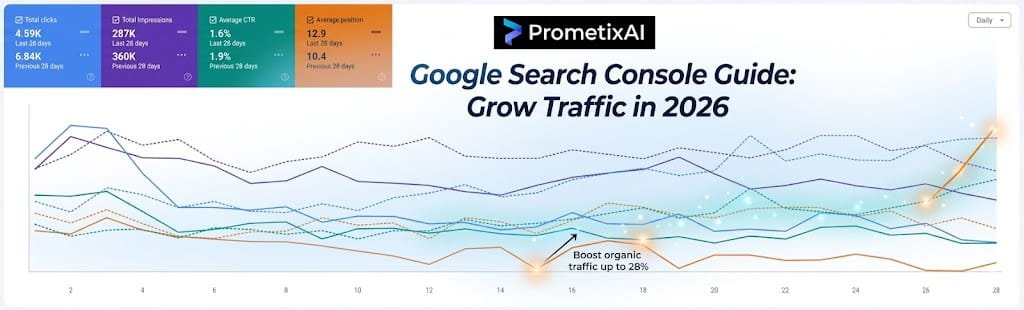
Impression Growth in Google Search Console
Impressions show how often pages appear in results even when users are not clicking yet. A steady upward trend means Google is testing your relevance for target queries.
Rising Crawl Frequency
When Googlebot visits your site more often, Google is treating your domain as a more valuable source. You can check this inside Google Search Console under Crawl Stats. Rising crawl frequency ahead of ranking improvements is a reliable early signal the work is landing.
Other early indicators:
- Branded search volume growing in Google Search Console
- Position improvements on low-competition, long-tail queries
- Time-on-page metrics rising as content quality compounds
Already 3 months in? See if your SEO foundation is actually building.
We review your impressions trend, crawl frequency, and topical index coverage — and tell you exactly what they mean for your next 90 days and when to expect your first traffic gains.
Get my health check → Read more guides →Realistic SEO Timelines for Businesses
| Business Type | Competitive Level | Realistic Timeline to Page 1 |
| Local service (plumber, dentist) | Low to medium | 3 to 6 months |
| Niche B2B SaaS | Medium | 6 to 12 months |
| E-commerce (category pages) | High | 9 to 18 months |
| Enterprise or broad SaaS | Very high | 12 to 24+ months |
These are not pessimistic numbers. They are what practitioners see when SEO is done correctly. SaaS companies with fewer than 50 employees consistently hit a wall around month three when they expect traffic but are still in the foundation phase.
Teams that quit before month six often bail out right as the work from months one through four is starting to pay off.
Conclusion
Why SEO takes time is not a flaw in the system. It is the system working exactly as designed. Google rewards consistent, authoritative work because that is what actually serves users.
Brands that accept that reality build a compounding channel. Brands that chase shortcuts spend months recovering while competitors pull further ahead.
So if you are three months into a campaign and traffic has not moved, check your leading indicators first.
Growing impressions, rising crawl frequency, and expanding index coverage all tell you the foundation is landing. The traffic follows the trust. Not the other way around.
If you want to turn that foundation into measurable rankings and AI search visibility, talk to the PrometixAI team.
Start Now →