SEO in 2026 is weird, unpredictable, and still responsible for 53% of web traffic.
Algorithms evolve weekly. AI rewrites ranking signals. But the core debate still drives every strategy discussion: on page vs off page seo.
If you want sustainable rankings, authority, and conversions, you must master both.
This guide breaks down differences, overlaps, and execution frameworks so you can outperform competitors and rank across search engines and LLM systems.
Understanding On-Page SEO
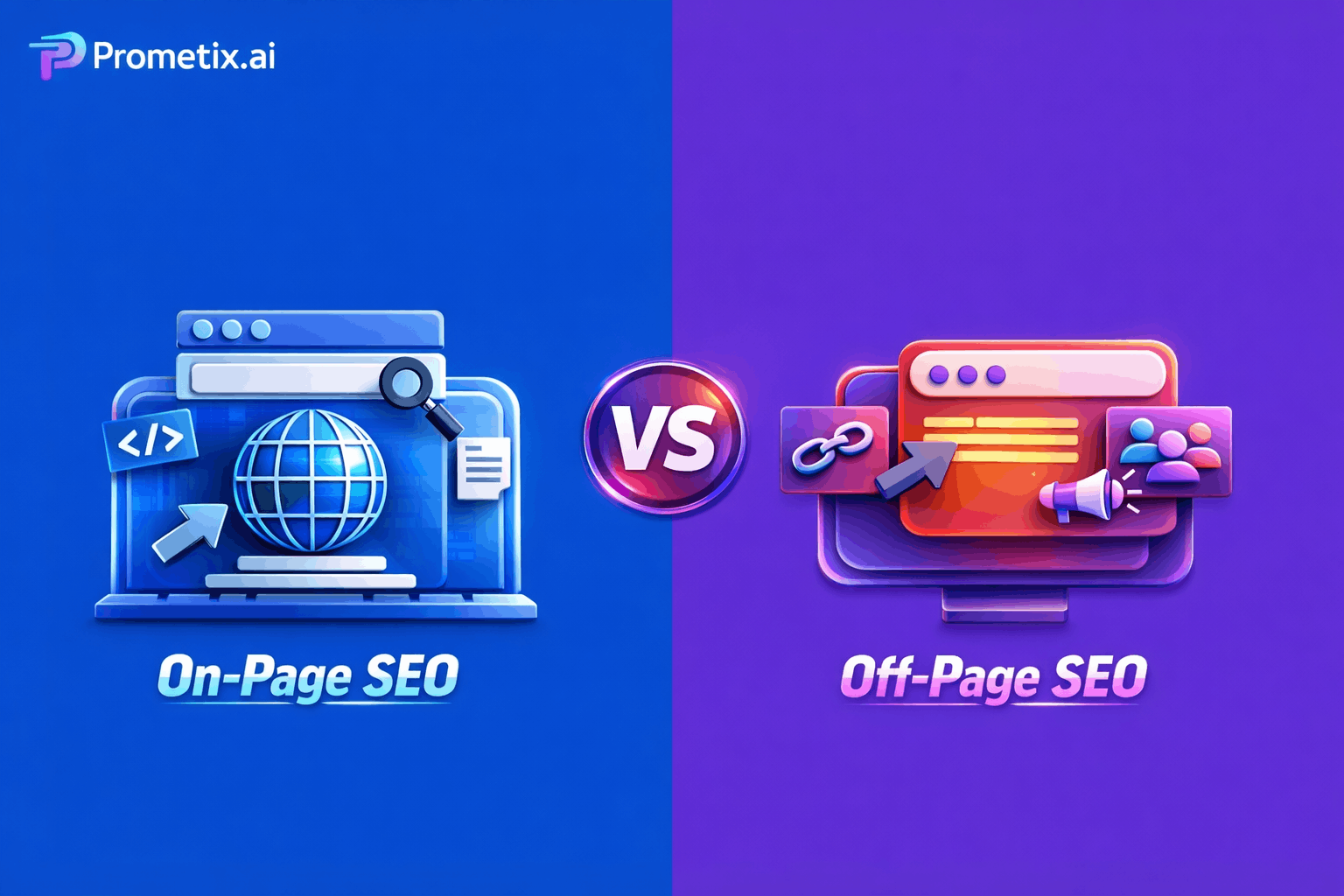
When analyzing on page vs off page seo, on-page always sets the baseline.
On-page SEO includes every optimization executed directly within your website. Content structure, keyword placement, technical signals, and user experience all fall under this umbrella. Search engines rely on these signals to interpret meaning, relevance, and value.
And clarity drives rankings.
Strong on-page SEO ensures crawlers understand your topic depth. It also ensures users find answers quickly. That combination improves dwell time, reduces bounce rates, and increases conversion probability.
Key components include site architecture, content relevance, internal linking, and technical markup. Without these foundations, off-page signals lack context.
So when comparing on page seo vs off page seo, think of on-page as the infrastructure layer that determines interpretability and usability.
Keyword Optimization Techniques
Keyword optimization remains central to on page vs off page seo performance. But execution has matured.
Modern search engines analyze search intent, entity relationships, and semantic relevance. Exact match keywords alone do not guarantee rankings. Contextual integration does.
Effective keyword optimization requires layered implementation.
Start with keyword research. Identify high-intent queries tied to your audience’s decision journey. Focus on informational, navigational, and transactional blends.
Then prioritize placement. Integrate keywords into high-impact zones:
- Title tags
- H2 and H3 subheadings
- Opening 100 words
- Meta tags
- Anchor text
Next comes expansion. Use LSI phrases like search engine optimization, keyword research, and semantic search to reinforce topical authority.
So when structuring content around on-page vs off-page seo, optimization must feel natural, contextual, and reader-first.
Because readability now influences rankings as much as relevance.
Improving Content Quality
Content quality determines whether optimization efforts translate into rankings.
Search engines evaluate expertise, originality, and depth. Thin content rarely survives competitive SERPs. Comprehensive resources dominate.
High content quality requires structured formatting, expert insights, credible data, and actionable frameworks. Paragraph flow also matters. Short blocks improve readability and engagement.
And engagement drives performance.
If users scroll, interact, and share, algorithms interpret value. That feedback loop strengthens both on page vs off page seo outcomes simultaneously.
To improve content quality:
- Address real user questions
- Include case examples
- Add updated statistics
- Improve formatting clarity
Strong content attracts backlinks organically. It also builds brand trust.
And trust compounds rankings.
Technical Elements: Meta Tags and Headers
Technical optimization forms the interpretive bridge between content and search engines.
Meta tags summarize page intent. Title tags influence click-through rates. Meta descriptions shape SERP perception.
Headers create hierarchy. H1 establishes primary focus. H2 and H3 structure topical flow. They also create additional keyword placement opportunities for phrases like off page vs on page seo and on page seo vs off page seo.
Proper technical implementation improves crawl efficiency, indexing precision, and ranking eligibility.
But technical gaps create friction. Missing meta tags, duplicate titles, and poor header nesting reduce clarity.
So within on page vs off page seo, technical SEO ensures search engines read your content the way you intend.
Core Web Vitals Significance
Performance metrics now influence rankings directly.
Google Core Web Vitals measure real user experience across three dimensions: loading speed, responsiveness, and visual stability.
Largest Contentful Paint evaluates load performance. First Input Delay measures interactivity. Cumulative Layout Shift tracks layout stability.
Slow websites increase bounce rates. High bounce rates suppress rankings.
So even with strong backlinks in on page vs off page seo, poor performance weakens outcomes.
Optimizing Core Web Vitals requires image compression, script minimization, and server optimization.
Speed improves satisfaction. Satisfaction improves rankings.
Mobile Responsiveness and User Experience
Mobile-first indexing defines modern search evaluation.
Search engines primarily assess mobile site versions when determining rankings. If your site underperforms on smartphones, your visibility declines.
Responsive design ensures layout adaptability across devices. Text readability, button spacing, and navigation simplicity all influence user engagement.
User experience extends beyond layout.
It includes load time, accessibility, and interaction flow. Positive UX increases dwell time and reduces friction.
So within on page vs off page seo, user experience acts as a shared ranking amplifier.
People engage more with sites that feel effortless.
Internal Linking Strategies
Internal linking strengthens structural clarity and authority distribution.
It connects related content, guiding both users and crawlers through your ecosystem. Strategic linking improves crawl depth and topical clustering.
Effective internal linking includes contextual anchors, logical hierarchies, and conversion-focused pathways.
It also supports product discovery and service visibility.
If you want AI-driven frameworks that optimize site architecture and authority flow, explore SEO solutions at Prometix AI.
Internal links transform isolated blogs into ranking networks.
Delving into Off-Page SEO
If on-page signals relevance, off-page signals trust.
Off-page SEO includes all optimization activities occurring outside your website. Search engines use these signals to evaluate credibility, popularity, and authority.
So when comparing on page vs off page seo, off-page determines how the web perceives your brand.
The Role of Link Building
Backlinks remain one of the strongest ranking factors.
When authoritative domains link to your site, search engines interpret that as validation. But quality outweighs volume.
High-impact backlinks originate from editorial publications, research platforms, and niche authorities.
Effective link building strategies include guest publishing, digital PR, and data-driven content marketing.
Spammy backlinks create penalties. Ethical acquisition builds sustainable rankings.
So in off page vs on page seo, link building drives authority acceleration.
Social Media Engagement Impact
Social media does not function as a direct ranking factor. But its indirect influence is undeniable.
Content amplification increases visibility, traffic, and backlink probability. Viral distribution accelerates brand discovery.
Platforms like LinkedIn and YouTube extend reach beyond traditional search environments.
So while social engagement sits outside technical on-page vs off-page seo structures, it strengthens off-page signals through awareness and link attraction.
Visibility fuels authority.
Gaining Brand Mentions
Brand mentions function as trust signals.
Search engines track citations across articles, reviews, podcasts, and forums. Even unlinked mentions reinforce legitimacy.
Consistent brand visibility indicates market relevance. That relevance influences entity recognition within search ecosystems.
So within on page seo vs off page seo, mentions act as credibility multipliers.
They validate expertise beyond owned platforms.
Enhancing Domain Authority
Domain authority reflects cumulative trust strength.
It develops through backlink quality, brand mentions, and historical performance signals. High-authority domains rank faster and resist algorithm volatility.
Improving authority requires long-term investment.
Publishing proprietary research, earning media coverage, and building partnerships all contribute.
Authority compounds gradually. But once established, it accelerates every SEO initiative tied to on page vs off page seo.
Building Online Reputation
Reputation influences both rankings and conversions.
Reviews, testimonials, and public sentiment shape trust perception. Negative reputation suppresses engagement and link acquisition.
Reputation management includes review monitoring, transparent responses, and customer experience optimization.
So while reputation belongs to off-page SEO, it directly impacts on-page engagement metrics.
Trust drives clicks. Clicks drive rankings.
The Synergy Between On-Page and Off-Page SEO
How They Complement Each Other
The real power of on page vs off page seo emerges through integration.
High-quality content attracts backlinks naturally. Backlinks elevate content visibility. Increased visibility drives engagement.
It is a feedback loop.
Without on-page clarity, off-page authority lacks context. Without off-page authority, on-page content struggles to surface.
So synergy, not separation, defines modern SEO success.
Strengthening Search Engine Rankings
Search rankings rely on multi-signal alignment.
On-page SEO delivers relevance through content, keywords, and structure. Off-page SEO delivers trust through backlinks and mentions. Technical SEO delivers performance.
When these signals converge, rankings stabilize even during algorithm updates.
And stability defines competitive advantage in on page vs off page seo execution.
Evolving SEO Strategies with AI and Algorithm Updates
Adapting to Search Engine Changes
Search ecosystems evolve continuously.
AI-driven ranking systems evaluate helpfulness, originality, and expertise more accurately than ever. Frequent updates reward adaptive strategies and penalize stagnation.
Continuous audits, content refresh cycles, and SERP analysis are now mandatory.
Rigid optimization frameworks collapse under algorithm pressure.
Adaptability sustains rankings.
Integrating AI into SEO Tactics
AI now powers advanced search engine optimization workflows.
It enhances keyword research, predicts ranking gaps, and automates technical audits. It also improves content optimization through semantic modeling.
AI tools analyze search intent clusters and recommend structural improvements that strengthen both on-page SEO and off-page SEO performance.
Machine intelligence accelerates execution while preserving strategic precision.
And speed matters in competitive SERPs.
SEO for Small Businesses
Small businesses often view SEO as resource-intensive.
But targeted execution delivers disproportionate returns. Local search optimization, niche backlinks, and focused content strategies drive visibility efficiently.
Optimizing Google Business profiles, acquiring reviews, and publishing localized content strengthens authority.
So within on page vs off page seo, small brands win by focusing depth over breadth.
Specificity beats scale.
Leveraging Expert Insights
Expert guidance accelerates growth.
Consultants and AI platforms identify structural gaps, toxic backlinks, and missed keyword opportunities quickly.
They also design integrated frameworks where on page seo vs off page seo strategies reinforce each other.
Strategic clarity reduces experimentation costs.
And precision accelerates rankings.
Utilizing Tools to Streamline Processes
SEO execution requires operational efficiency.
Advanced tools track rankings, audit technical health, and analyze backlink profiles. Automation reduces manual workload and improves reporting accuracy.
Popular platforms support keyword optimization, competitor benchmarking, and content performance tracking.
Efficiency ensures consistent execution across both on page vs off page seo initiatives.
Boosting Visibility in the Digital Space
Digital visibility determines market competitiveness.
When on-page relevance aligns with off-page authority, brands dominate search landscapes. They capture traffic across awareness, consideration, and decision stages.
This visibility compounds lead generation, conversions, and revenue growth.
And sustained dominance requires continuous alignment between on page vs off page seo strategies.
Conclusion
The debate around on page vs off page seo often frames them as competing forces.
But real SEO growth happens when relevance and authority evolve together. On-page builds the experience. Off-page builds the reputation.
Master both, and rankings follow. So here is the final question.
Are you optimizing pages… or building digital authority that search engines cannot ignore?
👉 If you are ready to move from understanding on page vs off page SEO to executing both with clarity, structure, and data-backed prioritization, explore how PrometixAI supports the entire SEO optimization workflow.
What is On-Page SEO?
On-Page SEO optimizes elements within your website, including content, keywords, meta tags, internal links, and user experience, to improve search visibility, relevance, and rankings.
Where does technical SEO fit in?
Technical SEO sits within on-page SEO, focusing on site speed, crawlability, indexing, structured data, mobile responsiveness, and Core Web Vitals to support rankings.
What is Off-Page SEO?
Off-Page SEO includes external signals like backlinks, brand mentions, reviews, and social engagement that build authority, credibility, and trust in search engines.
How does local SEO and citations work?
Local SEO uses business listings, NAP consistency, maps optimization, and directory citations to improve visibility in location-based searches and local pack rankings.
How does local SEO support off-page strategy?
Local SEO strengthens off-page SEO through citations, reviews, and directory backlinks, reinforcing authority, trust signals, and geographic relevance for search engines.
Why Are Both On-Page & Off-Page SEO Important?
On-page SEO builds relevance and usability, while off-page SEO builds authority and trust; together they create balanced signals required for sustainable search rankings.