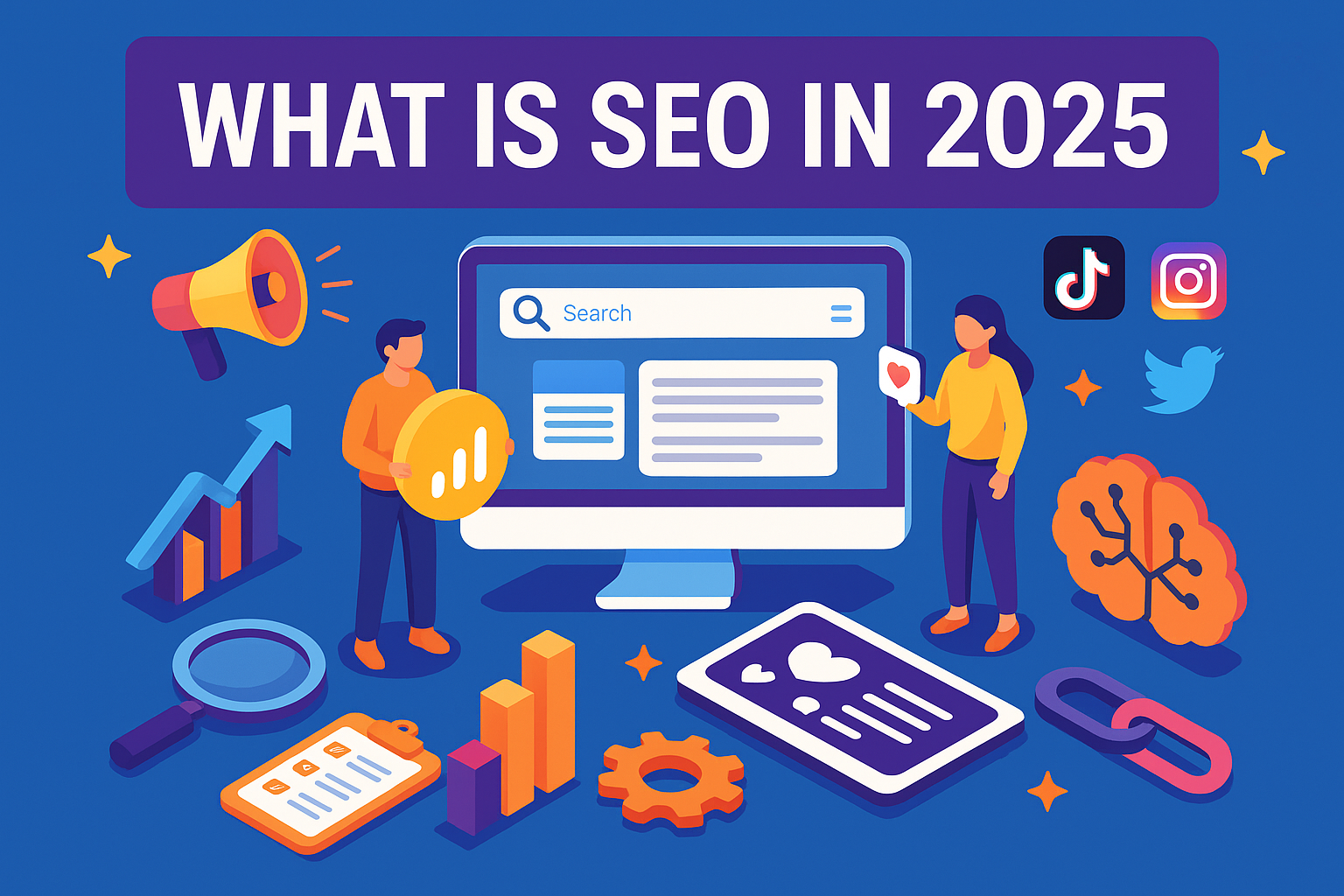
Search Engine Optimization (SEO) used to be about keywords, links and hoping you’d rank in Google Search. In 2025 it’s far more layered.
With advanced AI, massive social media ecosystems, and shifting user behaviour, SEO now demands a hybrid approach. It’s not just about showing up in traditional search anymore. You must win visibility across search engines, social platforms, and even language-models.
At PrometixAI, we’re seeing SEO evolve into something that blends traditional search strategy, social-media presence, and specific features tailored for large-language-model (LLM) ranking. If you want to stay ahead, this is your complete guide to what SEO in 2025 really means.
The evolution of SEO: from keywords to context
When SEO began, stuffing keywords, building lots of backlinks and gaming meta-tags could get you decent rankings.
Over time, Google and other engines got smarter: they penalised over-optimisation, emphasised user experience, and rewarded authority. Today, we live in the era of AI-powered search and multi-channel visibility.
Algorithms don’t just look at words on a page; they analyse intent, context, content quality, user engagement signals, and even how content appears on social platforms and within AI systems.
For example, readability, structured data, semantic associations, and real-world usage matter a lot more than raw keyword density. According to modern guides on blog structure and SEO, clear headings, short paragraphs, and scannable content boost both readability and search ranking.
Why traditional SEO still matters
Even in this new world, traditional SEO fundamentals remain critical. Optimising your title tag, meta description, header structure (H1, H2…), and internal links still sets the foundation. A clean URL structure, fast page load, mobile-first design, and secure site (HTTPS) still play big roles.
Search engines still crawl and index your pages, evaluating signals such as:
- backlink quality and relevance
- user behaviour (bounce rate, time on page, click-through patterns)
- overall content clarity and depth
- internal link structure
- page speed and mobile performance
- technical stability and security (HTTPS, no broken links)
If you neglect these basics, you’ll miss the foundation you need to rank, no matter how strong your social presence or AI visibility is. Traditional SEO is the base layer; without it, nothing else sticks.
The social-media & platform presence layer
In 2025, ranking is no longer just about Google search results. You need presence on social media and other platforms because:
- Social signals boost reach: Mentions on TikTok, Instagram, X, and other platforms amplify visibility and drive traffic.
- Search engines read social trends: Modern algorithms factor in social signals, trending topics, and platform content.
- Discovery happens everywhere: Users now find content through feeds, apps, and voice assistants — not just Google search.
- Lack of social = lost visibility: If you only rank in search but have no social presence, you lose a major share of discovery.
Thus, in 2025, you must integrate your SEO strategy with your social-media strategy: pushing the same core content, adapting for each platform, and ensuring you’re visible where your audience spends time.
For example, create short-form video summaries of your blog post, publish snippets on social, link back to the main article, and optimise your social-platform meta (OG tags, thumbnails, captions) to drive clicks.
LLM SEO: ranking for AI systems and conversational engines
This is the frontier. With large language models (LLMs) powering more search-type queries (via chatbots, voice assistants, embedded tools), you must optimise not just for traditional search, but for how AI systems surface answers. Here are some of the features you’ll need:
- Structured, high-quality data: Use schema markup (FAQ, How-To, Article) so AI systems can parse and reuse your content.
- Concise, authoritative answers: Add clear “question → answer” sections to get featured in chat-style results.
- Semantic context & entity linking: Use internal links and explanatory context to help LLMs map your relevance.
- Multi-channel citations: Gain mentions across social platforms, forums, and niche communities to strengthen authority.
- Snippet-friendly writing: Use short paragraphs, bullets, and simple definitions for AI-friendly extraction.
- Voice-intent alignment: Give a precise, direct answer near the top for voice assistant queries.
By optimising for LLM-driven discovery you get a double win: you serve traditional search engines and you position yourself in the next generation of search experiences.
Key features of high-performing SEO content in 2025
Successful content in 2025 pairs these features together:
- User-first writing: short paragraphs, varied sentence length, conversational tone.
- Strong topical depth: cover the theme comprehensively, so your page becomes a reference.
- Multi-format support: embed videos, infographics, social snippets, podcasts—search engines and platforms favour rich content.
- Internal linking & topic clusters: create content hubs and link to/from related posts to build authority.
- Social hooks: craft titles and meta descriptions that work for both search and social media sharing.
- Schema markup: FAQ, HowTo, Article types help search engines and LLM systems.
- Performance & UX: site speed, mobile responsiveness, accessible design — still must be nailed.
- E-A-T signals (Expertise, Authoritativeness, Trustworthiness): work harder now that AI systems check context in broader ways (references, citations, author bios).
- Continuous content refresh: update your content frequently as AI and search algorithms evolve; stale content loses visibility.
How to integrate all three layers: traditional + social + LLM-SEO
Bringing these layers together gives you the competitive edge. Here’s how to do it:
Start with your core article optimised the traditional way: keyword research, headline, intro, body, conclusion, meta tags, internal links, schema.
Then create a social-media push: convert your key points into short-form content (videos, carousel posts, tweets), link everything back to your article, use hashtags and engage with platform-specific audiences.
Then implement LLM-SEO optimisation: add FAQ sections, write concise summary paragraphs, improve semantic context, add structured data, generate short-answer boxes at top of your article for voice assistants.
Finally monitor and iterate: track not only search rankings but social engagement, mentions, how often your content is used in answer boxes or voice search. Refresh the content periodically, repurpose social snippets, and refine for changing algorithms or platform features.
What’s changed in ranking signals by 2025
By 2025 some shifts are clear:
- Backlinks remain important, but quality and context matter more than volume. Social-mentions, brand signals and offline references count more.
- Search engines and LLM systems use user behaviour (time on page, repeat visits, shares) as stronger signals.
- Voice search and assistive devices contribute higher share of queries, meaning your content must be legible as a spoken/short answer.
- Social platforms supply signals that spill over into search visibility. If your content “trends” or is widely referenced, you’ll see lift
- Rich-results and instant answer features dominate SERPs, capturing these is essential for visibility.
- AI-generated summary cards (from LLMs) may pull from your content, so being selected for those cards gives huge visibility.
- The importance of on-domain topic authority has increased. Publishing many shallow pages won’t cut it; you need comprehensive, modern content hubs.
What this all means for your business (and for you)
For businesses and marketers using a tool like PrometixAI, here’s what to take away:
Your SEO strategy must be more holistic. You can’t just worry about Google ranking. You must worry about how your content appears on social feeds, how it’s seen by voice assistants or chatbots, how the audience engages with it across platforms.
Allocate resources accordingly: invest not just in blog-posts, but social content, video, audio, interactive elements. Ensure your blog is built on strong technical foundations. Build content that’s structured for traditional search and adapted for LLMs.
Measure outcomes differently: today you track search positions and social shares, mentions, voice-search traffic, snippet appearances. At PrometixAI we help clients tie all these layers together so they’re not chasing one narrow metric.
Getting started: your 2025 SEO checklist
Here’s a simplified checklist to get rolling:
- Pick your main keyword and intent
- Write short, clear paragraphs
- Add quick Q→A near the top
- Use schema where relevant
- Create social snippets
- Ensure fast, mobile-first pages
- Add internal links
- Publish and promote
- Track search + social + voice
- Refresh every 3–6 months
Why you should act now
Because the landscape is moving fast. The users who are discovering content in 2025 are far more likely to use voice, chat assistants, social platforms and AI-powered discovery tools.
If you wait while others optimise for the future, you’ll lose the advantage. Getting ahead now means you’ll be among the first to be picked up by AI answer cards, snippet features and cross-platform visibility.
At PrometixAI we specialise in aligning traditional SEO, social-media strategy and LLM-friendly content so you dominate all entry points. If you’re ready to upgrade your SEO game, drop us a line — let’s talk about building visibility that spans search engines, social platforms and AI systems.
The future of SEO is now
SEO in 2025 isn’t just about keywords and links anymore. It’s about being where your audience is, being readable by machines and humans alike, and being prepared for discovery not only on search engines but on social platforms and conversational agents.
Blend the old fundamentals with newer features, optimise for AI and voice, and you’ll set yourself up for visibility, relevance and growth. The future is here, time to step in.
Let’s build that future together.