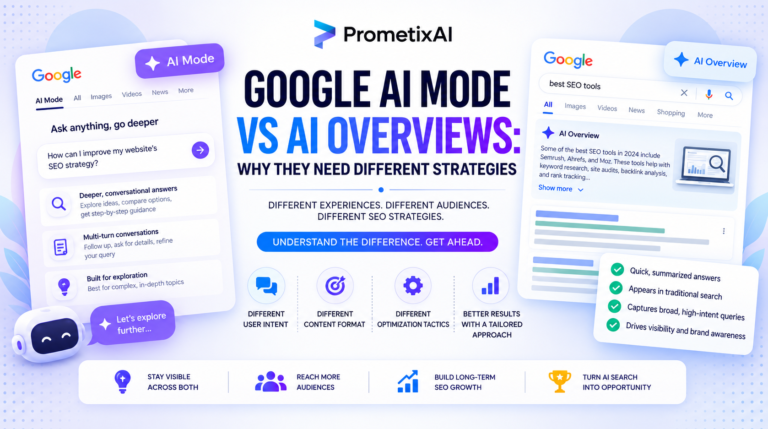
If you’ve watched your organic traffic dip even as your rankings hold steady, AI Overviews are probably why. Learning how to rank in AI Overviews is quickly becoming one of the most important skills in modern SEO, since Google now answers a huge share of queries directly in the search results before a user ever clicks through.
This guide breaks down exactly how to rank in AI Overviews, what Google’s systems are actually looking for, and the tactics that consistently get content cited. By the end, you’ll have a clear framework for how to rank in AI Overviews on your own site, not just a list of theories.
How Google AI Overviews Actually Work
AI Overviews are generated using a retrieval-and-synthesis process. Google’s systems pull from a set of credible, relevant pages, then use a language model to summarize that information into a direct answer.
Unlike traditional blue-link rankings, getting cited here isn’t just about keyword matching, it’s about whether your content is structured in a way the model can easily extract and trust.
This matters because the model isn’t reading your page the way a human does. It’s scanning for clearly bounded chunks of information it can lift cleanly, attribute confidently, and combine with other sources.
Understanding this distinction is the first step in figuring out how to rank in AI Overviews consistently, rather than getting cited once and disappearing from future Overviews on the same topic.
Why Traditional SEO Alone Isn’t Enough
Ranking #1 in classic search results doesn’t guarantee a citation in an AI Overview. Google’s generative system favors content that answers questions clearly, concisely, and with strong topical authority.
This is part of why so many marketers are searching for how to rank in AI Overviews specifically, separate from general SEO advice. The signals overlap, but they aren’t identical.
A page can rank highly in traditional search while never appearing in an Overview, and a page with a modest position three or four can still get pulled into the summary if it answers the question more directly than the top result.
This is exactly why how to rank in AI Overviews has become its own discipline within SEO teams rather than an afterthought bolted onto existing strategy.
Core Factors That Influence AI Overview Visibility
Several factors consistently show up across pages that get cited:
- Content clarity – direct, well-structured answers near the top of the page
- Topical authority – comprehensive coverage of a subject, not just a single keyword
- Structured data – schema markup that helps Google parse your content
- E-E-A-T signals – clear authorship, credentials, and trustworthy sourcing
- Source diversity – Google tends to pull from multiple credible pages rather than one dominant result
Each of these factors plays a role in how to rank in AI Overviews, and skipping any one of them weakens your chances of being selected as a source.
Content clarity in particular tends to outweigh raw domain authority, which is good news for smaller sites trying to figure out how to rank in AI Overviews without a decade of backlinks behind them.
How to Rank in AI Overviews: Step-by-Step Tactics
Here’s where the real work happens. These are the tactics that move the needle.
1. Lead with a direct answer. Within the first 1-2 sentences of a section, answer the question being asked. This “answer-first” format is consistently rewarded by AI Overviews SEO best practices, and it’s often the single biggest lever for how to rank in AI Overviews on competitive queries.
2. Use clear, descriptive headers. Semantic HTML (H2s and H3s phrased as questions) makes it easier for Google to extract relevant chunks of your content.
3. Add a dedicated FAQ section. FAQ schema paired with concise answers is one of the most reliable ways to get cited in AI Overviews, since the format mirrors how the model presents information.
4. Build topical clusters. Internal linking between related pages signals depth and helps establish the topical authority Google looks for when deciding how to rank in AI Overviews results across an entire site rather than a single page.
5. Include original data or insights. Unique statistics, first-party research, or expert quotes give Google a reason to cite you specifically instead of a competitor.
6. Optimize for conversational queries. Long-tail, natural-language phrasing matches how people actually ask AI-powered questions, which is increasingly central to how to rank in AI Overviews for voice and chat-style search behavior.
If you only take one thing from this section, let it be this: how to rank in AI Overviews comes down to making your content as easy as possible for a language model to extract, trust, and quote.
PrometixAI audits your content, schema, and citation gaps, then builds the strategy to get you cited by ChatGPT, Gemini, AI Overviews, and Perplexity.
Talk to an AI SEO Expert →Technical Optimization Checklist
Beyond content structure, a few technical basics matter:
- Implement FAQ, HowTo, or Article schema where relevant
- Keep page speed fast, since slow pages are less likely to be crawled and reused
- Ensure mobile-friendliness and basic accessibility standards
- Maintain clean, crawlable site architecture
- Use descriptive alt text and structured headings throughout long-form pages
These technical ranking factors won’t replace strong content, but they remove friction that could otherwise stop Google from surfacing your page at all.
Teams that treat this checklist as optional tend to struggle the most with how to rank in AI Overviews, even when their writing is genuinely strong.
Measuring Success
Tracking AI Overview visibility is still evolving, but a few methods work well:
- Monitor branded and non-branded query impressions in Search Console for unusual click-through patterns
- Manually check target queries to see whether your content appears in the Overview box
- Use third-party AI visibility tools that track citations across AI Overviews SEO and other generative search surfaces
- Log which pages get cited over time so you can spot patterns in formatting or structure
If your goal is mastering how to rank in AI Overviews long-term, consistent tracking is what separates guesswork from a repeatable strategy.
Without measurement, it’s nearly impossible to know which changes actually moved the needle on how to rank in AI Overviews versus which ones simply coincided with an algorithm update.
How Long Does It Take to See Results?
Most teams asking how to rank in AI Overviews want a timeline, and honestly, it varies. Pages with existing authority and decent technical health can sometimes see citations within a few weeks of restructuring content into an answer-first format.
Newer or thinner sites often take longer, since Google needs more signals of trustworthiness before pulling a page into a summary. Patience paired with consistent iteration tends to outperform one-off optimization sprints.
It also helps to treat this as an ongoing process rather than a single project. Query patterns shift, competitors restructure their own content, and Google’s underlying models get updated regularly.
Revisiting your highest-traffic pages every few months to check formatting, freshness, and schema coverage keeps you from falling behind on how to rank in AI Overviews as the landscape evolves.
We broke down the data, the AI search shift, and whether traditional SEO still pays off this year. No fluff, just a straight answer.
Read the Full Breakdown →Common Mistakes to Avoid
- Burying the answer under long introductions
- Ignoring schema markup entirely
- Writing thin content that lacks topical depth
- Keyword stuffing instead of writing for clarity, a tactic that can actively hurt your chances rather than help with how to rank in AI Overviews
- Failing to update content as AI Overview ranking factors shift over time
Conclusion
Figuring out how to rank in AI Overviews isn’t about gaming a new algorithm, it’s about adapting to how people actually want information delivered: fast, clear, and trustworthy.
Focus on answer-first content, strong topical authority, and clean technical execution, and you’ll put yourself in a strong position as AI Overviews SEO continues to shape how search results are presented.
Start with one or two pages, apply these principles, and build from there. The sites that figure out how to rank in AI Overviews early will have a meaningful edge as generative search becomes the default way people find answers.