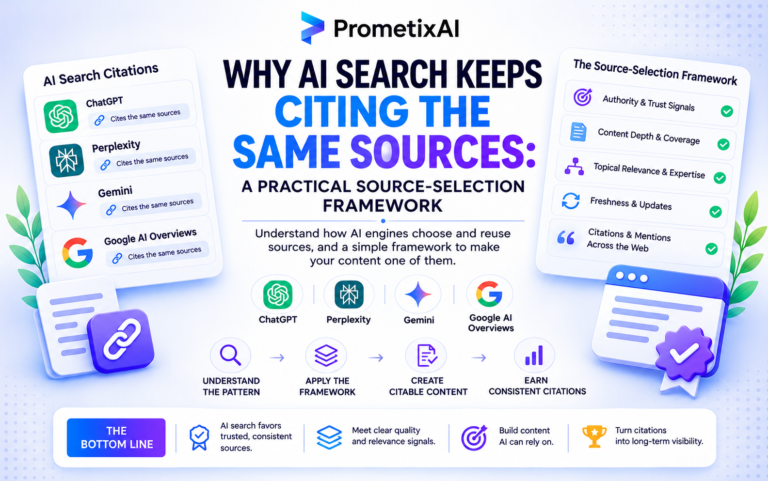
Reddit, Wikipedia, YouTube, LinkedIn, and Forbes are among the most cited sources in AI-generated answers.
And none of them earn that spot by rewriting every page every month.
So where does AI search content freshness actually fit? In this guide, you will learn when updates help citations, which pages to fix first, and when the smartest move is leaving a page alone.
Does AI Search Content Freshness Affect Citations?
Short answer: sometimes, and it depends on the question. AI search systems often pull live web pages when a prompt needs current facts, so a page with old prices or expired statistics can lose its spot to a more accurate source.
That is why freshness matters most for queries about pricing, product features, industry news, statistics, and regulations. But a solid page on a stable topic can keep earning citations for years, because its information has not expired.
The research on AI citations and freshness points the same way, with one big caveat. Seer Interactive analyzed 7,683 pages cited across ChatGPT, Gemini, and Perplexity and found that 75% had received an update within the past year. Here is where it gets interesting: only about 40% of those pages first went live that recently.
So most “fresh” citations came from older pages that someone kept maintaining. Still, this is a correlation, and it does not prove that the refresh caused the citation. Well-maintained pages often sit on stronger sites to begin with.
Google keeps the picture grounded too. Its guidance on generative AI features says these experiences rely on core Search systems to retrieve relevant, up-to-date pages, but Google never promises that a newer page beats a more useful older one. That makes AI search content freshness an accuracy question first and a date question second.
Why AI Search Content Freshness Matters More for Some Queries
The need behind a query decides how much recency matters. A prompt about this month’s pricing and a prompt about how crawling works ask very different things of a page.
Time-sensitive queries need current information
Some topics go stale fast. Think about prompts like these:
- Latest AI search tools and platform features
- Current software pricing and subscription plans
- Recent industry statistics and market reports
- New laws, regulations, and compliance rules
- Current product comparisons and recommendations
This is where AI search content freshness does its heaviest lifting. If your comparison still lists a plan the vendor retired in spring, an AI system has every reason to cite someone else.
Evergreen queries can benefit from older content
Other topics barely move. “What is technical SEO?”, “How does keyword research work?”, “What is a content management system?”, and “How do search engines crawl websites?” all have answers that stay accurate for years.
These pages do not need constant edits while their core concepts hold. And an older evergreen page with steady mentions often carries more trust than a brand-new rewrite, which shows why AI search content freshness is never a blanket rule.
Platform and query differences matter
AI platforms do not all retrieve sources the same way. In the same Seer dataset, 78% of Gemini citations pointed to pages updated in the past year, compared with 73% for ChatGPT and 65% for Perplexity.
Those numbers describe one sample, not fixed rules. So treat AI search content freshness as both query-dependent and platform-dependent, instead of assuming one engine always rewards newer pages.
Which Pages Should You Update First?
Rank pages by three factors: how fast the information decays, how much the page matters to revenue, and how much visibility it already has. A page that scores high on all three goes to the top of the queue.
1. Pricing and product comparison pages
Check prices, plan limits, features, availability, competitors, and your final recommendation. These pages can turn wrong the same day a provider changes its offer, which makes them the clearest case for AI search content freshness work.
2. Statistics and research-based articles
Replace outdated figures with current data, but verify first. Open the original report, check its date and methodology, and confirm the link still works before you swap a single number.
3. Technical guides and tutorials
Review the steps whenever an interface, API, or tool changes. When we audit client sites, tutorials with old screenshots and dead menu paths show up far more often than teams expect, and they quietly erode trust with readers and AI systems alike.
4. High-performing pages that are losing visibility
Look for pages that once earned traffic or AI citations but now show a sustained decline. Comparing date ranges in Google Search Console is the fastest way to spot that pattern, and it is often where AI search content freshness problems surface first.
Then figure out the cause. Sometimes the information aged, and sometimes a competitor simply published something more useful.
5. Core commercial and service pages
Update service descriptions, case studies, proof points, and calls to action whenever your offering changes. An AI answer describing a service you stopped selling helps nobody.
One rule applies across all five. A meaningful change in the information should trigger the update, not a calendar reminder.
When Should You Leave Existing Content Alone?
This is the decision most freshness guides skip. Good AI search content freshness work includes knowing when to stop, because the best update is sometimes no update at all.
Leave a page alone when:
- It covers a stable concept and remains accurate
- Its statistics and references still hold up
- It still attracts relevant traffic and citations
- Its examples and recommendations remain useful
- Its age is part of its value, like a historical analysis or original study
Do not refresh content just to change its date
Changing a publish date without real improvements is an old content freshness SEO trick, and a weak bet. Google’s byline date guidance asks for accurate, consistent dates and explains that its systems weigh several signals to estimate when a page was published or significantly updated.
So a new timestamp on unchanged content tells search systems something false. It also does nothing for AI search content freshness, because the information inside is exactly as old as it was yesterday.
How to Update Content for Better AI Citation Potential
A good refresh fixes what changed, fills what is missing, and leaves the rest intact. Use this checklist whenever you update content for AI visibility.
Verify facts, statistics, and references
- Check every time-sensitive number against its original source
- Replace discontinued products, retired features, and wrong prices
- Remove broken or superseded references
- Verify claims before calling them current
Improve sections that no longer answer user questions
Run the prompts and search queries the page should answer, then note which questions have grown more important. Add missing explanations, fix weak comparisons, and close the gaps that competing cited pages cover better.
Add original value instead of rewriting existing paragraphs
New research, expert input, practical examples, or fresh first-hand experience give AI systems something worth citing. Swapping synonyms to make a page look new adds nothing, and readers notice.
Update dates and technical signals accurately
Keep the original publication date where it makes sense, and change the modified date only after a meaningful update. Make sure the visible date matches your dateModified structured data, and update sitemap lastmod only when it reflects a real change.
These steps communicate accurate page information to search systems. They support AI search content freshness, but they do not guarantee a single citation.
How Often Should You Update Content for AI Search?
No evidence supports one universal schedule for AI search content freshness. So treat review intervals as editorial planning tools, not AI ranking requirements.
| Content type | Suggested review | Update trigger |
| Pricing and product comparisons | Every 1–3 months | Price, feature, or competitor changes |
| Industry statistics and reports | Every 3–6 months | New research or revised data |
| Technical tutorials | When relevant updates occur | Software, interface, or API changes |
| Commercial pages | Every 3–6 months | Changes in services, offerings, or proof points |
| Evergreen educational content | Every 6–12 months | Changes in underlying concepts or references |
Urgent changes skip the queue. A new regulation or an incorrect product detail should trigger an immediate fix, not wait for the next review date.
These intervals are editorial recommendations, not proven citation thresholds. They simply keep AI search content freshness on someone’s calendar so nothing important decays unnoticed.
How to Measure Whether Content Updates Improve AI Citations
You cannot judge a refresh without a baseline. Measuring before and after is the only honest way to separate real gains from normal AI answer swings.
Establish a baseline before making changes
Pick a fixed set of prompts the page should answer and test them across ChatGPT, Gemini, Perplexity, and Google AI Overviews. Record which responses cite your page, which competitors appear, and the date of each test.
If you already track AI visibility across a prompt set, you can reuse that same set here. It saves time and keeps your AI search content freshness tests comparable over months.
Compare results after the update
Retest the same prompts and compare citation rates by platform. Track changes in cited URLs and competitor visibility, check impressions and clicks in Google Search Console, and log exactly what you changed on the page.
Then run the numbers with this formula:
Citation Rate = (Responses citing your page ÷ Total responses tested) × 100
But one before-and-after test cannot prove causation. AI answers fluctuate between runs and after AI search updates, so repeated tests and a comparable group of untouched pages give you a much stronger read on whether AI search content freshness changes moved the needle.
Common AI Search Content Freshness Mistakes to Avoid
Most AI content freshness mistakes come from treating dates as the goal instead of accuracy. Watch out for these:
- Changing dates without updating information
- Adding the current year to every title
- Refreshing pages that remain accurate and useful
- Rewriting whole articles when one section needs a fix
- Swapping credible older research for weaker recent sources
- Reading a few days of citation drops as content decay
- Assuming every AI platform uses the same freshness signals
Conclusion
If you remember one thing, make it this: AI search content freshness is about whether your information is still true, not whether your page looks new. The Seer data backs that up, since most cited pages were older pages that someone kept accurate.
So stop scheduling refreshes by date and start triggering them by change. Fix pricing the day it moves, verify statistics before you swap them, and leave stable, accurate pages alone. That is how AI search content freshness turns into citation stability instead of busywork.
Want to know which of your pages AI platforms cite today and which ones need attention first? Talk to the PrometixAI team about our AI SEO services, and we will map your AI search content freshness priorities into a clear update plan.
FAQs
Does updating old content improve AI citations?
Yes, updating old content can improve its chances of earning AI citations when the changes make it more accurate, relevant, and useful. Refresh outdated statistics, broken links, examples, and recommendations. Focus on improving the information rather than making superficial edits just to signal freshness.
Does changing the publication date help AI search visibility?
No, changing the publication date alone does not improve AI search visibility. AI search engines look for relevant, reliable information rather than newer dates by themselves. Update the date only when you have made meaningful changes to the content.
How old can content be and still receive AI citations?
There is no fixed age limit for content to receive AI citations. Older pages can continue earning citations if they provide accurate, authoritative, and relevant information. However, topics involving technology, regulations, prices, or current trends may require more frequent updates.
Should I update every blog post every year?
No, updating every blog post annually is unnecessary. Prioritize pages with outdated information, declining organic traffic, broken links, or changing search intent. Evergreen content that remains accurate and performs well may not need frequent revisions. Focus on meaningful updates instead of following an arbitrary schedule.