ChatGPT led major AI platforms with a 57% verifiable citation rate, compared with 38% to 46% for its competitors.
So even for the top performer, 43% of cited statistics did not lead back to a matching study. That is a big clue about AI search source selection, because getting cited and being the best source are two different things.
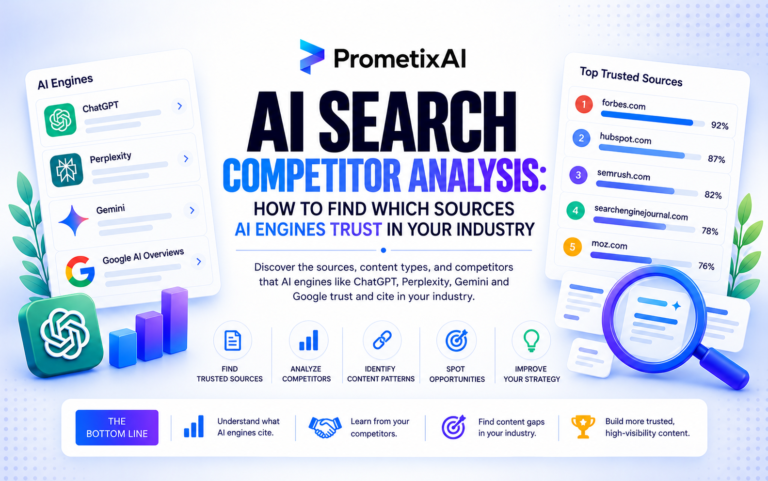
In this guide, you will know why the same sources keep appearing. You will also know how to find the ones shaping your market.
Why Does AI Search Keep Citing the Same Sources?
AI search keeps citing the same sources because those sources keep fitting the questions people ask. A secret whitelist is not the best explanation, and AI search source selection looks more like a repeating pattern than a VIP list. Here is what drives that pattern:
- Topical depth: publishers covering a subject from many angles
- Useful information: specific facts, comparisons, and research
- Independent views: review sites, forums, and research groups
- Access: pages the system can find and read
- Query fit: different questions pulling different sources
Picture an AI answer that mentions a software brand. Its citations might point to G2 for user feedback, an industry publication for a comparison, and the vendor’s documentation for technical specifications. That is one answer, three sources, three different jobs.
So read repeated citations as recurring visibility in the prompts you examined. They do not prove that a platform permanently trusts or prioritizes a domain, which means the phrase “trusted AI sources” deserves a small asterisk.
How AI Search Selects Sources for an Answer
Here is a simplified model of AI search source selection. It does not describe any platform’s private algorithm, but it shows where a page can win or drop out.
1. Understanding the question
The system first works out the intent, context, and limits behind a question. Someone asking for the best project management software for a remote team may care about pricing, integrations, security, and team size.
2. Expanding the question into sub-questions
Next comes query fan-out, where one complex question becomes several related searches. A remote team question might split like this:
- Which tools support remote collaboration?
- What are their pricing plans?
- Which integrations do they offer?
- How do their security features compare?
Google says AI Overviews and AI Mode may use query fan-out, but other platforms can work differently. Even inside Google, AI Mode and AI Overviews call for different strategies.
3. Retrieving and evaluating potential sources
This is a two-part job: finding candidate pages, then picking useful information from them. Relevance, evidence, clarity, and the exact detail needed can all shape AI search source selection here. So a system can find your page and still leave it out of the answer.
4. Building the answer and attaching citations
The system then combines the selected sources and writes its response. Citations may support particular claims, so AI search citations will not show you every page the system saw. That blind spot makes this process hard to study from the outside.
The Five Factors That Make a Source Worth Citing
These five factors give you a scorecard for AI search source selection. Use them to judge any cited page, including your own.
1. Relevance to the exact question
A source has to answer the need behind the prompt, not just share its broad topic. For a cost question, a detailed pricing page may beat a general software overview. So if you wonder why AI cites websites that look weaker than yours, check this first, because many misreadings of source selection in AI start here.
2. Verifiable information and evidence
Original research, named sources, and product specifications give a system something solid to use. A claim like “the fastest tool on the market” gives it far less.
But here is the thing. In the Trakkr study behind our opening stat, only 21% of first-cited pages were original research, while 54% were company blogs repeating figures. So a frequently cited page may simply be a popular copy of the evidence.
3. Independent credibility
People who want an honest comparison rarely want to hear only from the seller. One analysis of 1,851 cited sources on buying questions found only 2.8% were brand-owned pages.
And yet a Yext study of 6.8 million citations put first-party websites at 44%. Your mix depends on your prompts, and brand-owned pages still matter for official product details and documentation.
4. Clarity and extractable information
Direct answers, descriptive headings, focused paragraphs, and comparison tables make information easier to interpret. That is why writing chunkable content helps, since each section then stands on its own.
5. Accessibility and freshness
Useful content must be public and technically available to the relevant search systems. Our guide on getting cited in ChatGPT Search covers the technical checks. Freshness matters when information changes often, such as prices, regulations, and product features. You do not need to update every page on a fixed schedule.
A Practical AI Search Source Selection Framework
This is the hands-on part. We will use project management software as our example.
Step 1. Build a representative prompt list
Start with real questions customers ask at different stages of a decision. Keep the wording consistent, because a changed prompt can muddy your AI search source selection data.
- Informational: What is project management software?
- Problem-focused: How can remote teams manage projects?
- Comparison: Which tools are best for small agencies?
- Recommendation: What is the best tool for a 50-person remote team?
- Branded: How does Product A compare with Product B?
Begin with 20 to 30 relevant prompts rather than hundreds of loosely related queries. A set that size stays small enough to read by hand. If you want a full setup for building and freezing the library, see our guide to AI search prompt monitoring.
Step 2. Test prompts across relevant AI platforms
Run the same prompts through the platforms your audience uses, such as ChatGPT, Perplexity, Gemini, and Google AI experiences. Then record this for every run:
- Exact prompt, platform, and date
- Brands mentioned
- Cited URLs and domains
- The claim each citation supports
- Whether your own website appears
Analyze each platform separately, because each one behaves differently. The Trakkr study found ChatGPT quoted 1.3 statistics per answer while Gemini quoted 6.2. A blended average would hide that gap, along with the real AI search source selection pattern on each platform.
Step 3. Extract and categorize cited sources
Now pull every cited URL into a sheet and group it by type. This is where citation tracking gets useful, because you start seeing patterns in your AI citation sources.
- Brand websites and documentation
- Industry publications and news
- Review platforms and directories
- Community discussions like Reddit and Quora
- Research papers and reports
- Educational sites and specialist blogs
Look for recurring domains and pages. A domain that keeps appearing is a useful lead, but it is not automatic proof of authority. If community platforms dominate your list, our breakdown of why AI models cite Reddit so often explains what is going on.
Step 4. Identify why each source is being cited
Read the actual cited pages, because most of the value in AI search source selection research sits here. Decide whether each page adds original data, an independent review, technical specifications, a direct answer, or a useful comparison. Then match it to the sub-question it answers.
Here is the step most guides skip. When we audit a cited page that quotes a statistic, we click through to its source, because a recurring domain may just be the loudest copy of someone else’s research. So the asset worth building could be a properly sourced original number.
Step 5. Compare your visibility with recurring sources
Mark which needs your website already covers, and where other sources offer more. Check whether your content matches them on evidence, detail, clarity, and relevance.
Also list the third-party platforms where customers discuss or review your brand, since brand mentions there can shape answers. That turns AI search source selection from a curiosity into a to-do list.
How to Turn AI Search Source Selection Findings Into an Action Plan
A list of cited URLs does not fix anything by itself. This table connects common findings to a next move.
| What you find | What it may indicate | Recommended action |
|---|---|---|
| Competitors are cited, but your website is absent | Their pages may answer the prompt more effectively | Review their cited pages and find what your site lacks |
| AI mentions your brand but cites review websites | Third-party pages may provide independent evidence | Make your review platform profiles accurate and complete |
| Research organizations appear repeatedly | The prompts may require data or evidence | Publish original research or add credible sources |
| Community discussions appear frequently | Users may need real-world experiences or opinions | Monitor discussions and answer recurring questions honestly |
| Your page is retrieved but rarely cited | It may not give a clear, useful answer | Review the passage, its evidence, and its relevance |
| Different platforms cite different sources | Their retrieval processes may differ | Study each platform instead of applying one fix |
Treat these as diagnostic clues, since they cannot explain why a platform picked a source. So change one thing at a time and retest the same prompts. That keeps your AI search source selection work tied to evidence instead of hunches.
How to Monitor Changes in AI Citation Sources
Source analysis works best as a repeat habit, because cited pages keep shifting. Scrunch data puts citation half-life at 3.4 weeks on ChatGPT and 5.8 weeks on Perplexity. Good search monitoring covers these points:
- Retest the same prompt set regularly
- Track citation frequency by domain, URL, platform, and topic
- Watch for new sources replacing recurring ones
- Compare first-party and third-party citations
- Record whether content improvements change citations
A simple metric keeps your prompt tracking honest. It also keeps your visibility reports comparable.
Citation Rate = (Responses citing your website ÷ Total responses tested) × 100
So 12 citing responses out of 60 gives you a 20% citation rate. The number only means something when the prompt set, platform, location, and counting rules stay consistent. And keep it separate from brand mention rate or overall AI share of voice.
How PrometixAI Helps Brands Understand AI Source Visibility
Here is the one idea to keep: a repeated citation tells you what job a page did in an answer, and that beats any guess about who AI trusts. Once you can see those jobs, AI search source selection stops feeling random and gives you a list of what to build, fix, or earn.
Improving AI visibility starts with knowing which sources appear and where competitors earn citations. PrometixAI works as an AI visibility partner here, using structured research, content strategy, and ongoing analysis to connect citation patterns with practical SEO priorities.
Want a clearer view of the AI search source selection patterns in your own market? Explore our AI SEO services to see how PrometixAI can help you improve your AI search visibility.