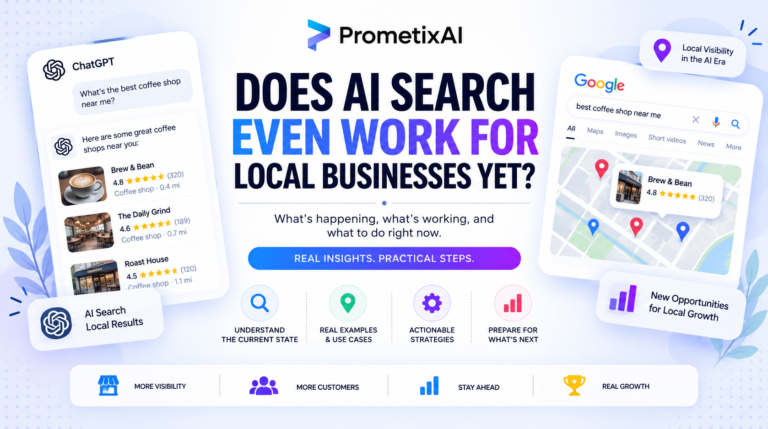
If you run a business that depends on customers finding you nearby, whether that’s a dental practice, a plumbing company, or a local retail store, your visibility in local search results directly affects how many people walk through your door. This local SEO checklist walks through every part of the process, from your Google Business Profile to the citations and links that build trust with search engines.
Local SEO isn’t a one time project. It’s an ongoing set of practices that, done consistently, keep your business visible when nearby customers search for what you offer. This guide is structured as a practical, step by step local SEO checklist you can work through in order, and if you’d rather have it handled for you, PrometixAI’s SEO services cover the entire process from setup to ongoing management.
What Local SEO Actually Controls (Map Pack vs. Organic)
Before working through a local SEO checklist, it helps to understand what you’re actually trying to influence. Google shows two distinct types of local results: the map pack (the three businesses shown with a map at the top of results) and the regular organic listings below it. These two placements are ranked using overlapping but not identical signals.
The map pack draws heavily from your Google Business Profile, your proximity to the searcher, and review signals. Organic local rankings lean more on your website’s content, backlinks, and technical SEO. A strong local SEO checklist addresses both, because many small businesses win one and miss the other entirely.
Step 1: Optimize Your Google Business Profile
Your Google Business Profile (GBP) is the single most influential asset in any local SEO checklist. It’s free, it’s the first thing most searchers see, and Google treats it as a primary trust signal for the map pack. Claiming and fully verifying your profile is the starting point of this local SEO checklist.
Categories, Attributes, and Services
Choose your primary category as precisely as possible rather than a broad catch all. Add secondary categories only when they genuinely describe services you offer, since irrelevant categories can dilute relevance rather than expand it. Fill in every attribute Google offers, such as wheelchair accessibility, payment types, or service options, since these fields are used to match your profile to specific search queries.
List your services individually with short descriptions rather than leaving the services section blank. This section functions almost like a mini landing page inside your profile, and it gives Google more text to match against long tail local searches, which is another reason this step belongs early in any local SEO checklist.
Photos, Posts, and Q&A
Upload real photos of your location, staff, and work rather than relying on stock imagery. Profiles with regularly updated photos tend to earn more clicks, and fresh uploads signal to Google that the listing is actively maintained. Add new photos on an ongoing basis rather than a one time upload.
Use GBP Posts to share updates, offers, or events, since they appear directly on your profile and give searchers a reason to choose you. The Q&A section is public and editable by anyone, so it’s worth monitoring and answering questions yourself before an outdated or incorrect answer gets upvoted.
Step 2: Fix NAP Consistency Across the Web
NAP stands for Name, Address, and Phone number, and consistency across every place your business is listed online is a foundational part of any local SEO checklist. When your NAP details differ between your website, GBP, and directory listings, search engines have a harder time confirming that all these mentions refer to the same business.
Start by searching your business name along with your city to see what listings already exist. Compare each one against your official details and correct any mismatches, including small formatting differences like “St.” versus “Street” or an outdated suite number. This cleanup step is tedious but it removes friction that can quietly hold back your local rankings, which is why it earns its own line in this local SEO checklist.
Step 3: Build Local Citations That Matter
Citations are mentions of your business NAP details on other websites, whether or not they link back to you. General directories like Yelp, Apple Maps, Bing Places, and the Better Business Bureau form the foundation, and getting listed accurately on these is a core part of any local SEO checklist.
Beyond the general directories, look for citation sources specific to your industry. A local law firm benefits from legal directories, while a restaurant benefits from food and hospitality platforms. These niche citations tend to carry more relevance signal than generic directory submissions because they connect your business to the right category of sites, and skipping them is one of the most common gaps in an incomplete local SEO checklist. Any thorough local SEO checklist treats niche citations as equally important as the general directories.
Step 4: Earn and Manage Reviews
Reviews influence both rankings and conversion rates, which makes them one of the highest leverage items on any local SEO checklist. Google factors in review count, review recency, and average rating when ranking the map pack, and searchers themselves lean heavily on reviews when deciding which business to contact.
Build a simple, repeatable process for asking satisfied customers to leave a review, whether that’s a follow up email, a text message, or a QR code at checkout. Respond to every review, positive or negative, since a thoughtful response to a negative review often reassures future customers more than the absence of any negative reviews at all.
Step 5: Localize On-Page Content and Landing Pages
Your website still matters for local SEO, particularly for the organic results that sit below the map pack. Make sure your city and service area are clearly mentioned in your page titles, headings, and body content, not just buried in the footer. This is also the point in a local SEO checklist where AI search visibility starts to matter, since AI tools pull from the same clearly localized content when answering local queries.
If you serve multiple neighborhoods or nearby towns, build dedicated pages for each rather than trying to rank one generic page for every location. Each page should include genuinely unique content about that area, such as landmarks you’re near or specific services you offer there, rather than a copy pasted template with the city name swapped out.
Step 6: Build Local Links and Community Signals
Links from other local websites carry outsized weight in a local SEO checklist because they reinforce your business’s connection to a specific geographic area. Sponsoring a local youth sports team, joining your chamber of commerce, or partnering with nearby complementary businesses can all generate these kinds of links naturally.
Local news coverage and community organization websites are also worth pursuing, especially if you have a newsworthy angle like a grand opening, a community event, or a milestone anniversary. These links tend to be harder to earn than directory citations, but they carry more trust because they come from established, geographically relevant sources, and they round out a well built local SEO checklist.
Tracking Local Rankings the Right Way
Local rankings fluctuate based on the exact location of the person searching, which makes tracking more complex than standard organic rank tracking. Use a rank tracking tool that supports geo grid tracking, showing you how you rank from multiple points across your service area rather than a single average position.
Pair rank tracking with your Google Business Profile insights, which show how customers found your listing and what actions they took, such as calls, direction requests, or website clicks. Revisiting this local SEO checklist on a quarterly basis, rather than treating it as a one time setup, is what keeps rankings stable as competitors and algorithms change. If you want a second set of eyes on where you stand, PrometixAI can run through this local SEO checklist against your current profile and site.
Frequently Asked Questions
How long does local SEO take to show results?
Most businesses following a full local SEO checklist start seeing movement in Google Business Profile visibility within the first few weeks, since GBP changes can be indexed quickly. Organic rankings and citation driven authority tend to build more slowly, often over a few months, since they depend on consistency accumulating over time. This is a big reason this local SEO checklist frames setup and ongoing maintenance as two separate phases.
Do I need a website if I have a strong Google Business Profile?
A Google Business Profile alone can generate calls and direction requests, but it can’t rank in the organic results below the map pack and it limits how much you can say about your services. A website gives you room to target more keywords, build local landing pages, and earn backlinks, all of which support the map pack indirectly, which is why both pieces belong in a complete local SEO checklist.
How many reviews do I need to rank?
There’s no fixed number that guarantees a ranking position, since Google weighs review count alongside rating, recency, and the review profiles of competitors in your area. A useful benchmark is to look at how many reviews the businesses currently ranking above you have, and aim to steadily close that gap rather than chasing an arbitrary total, which is the approach this local SEO checklist recommends over fixating on a single number.
What’s the difference between local SEO and regular SEO?
Regular SEO focuses on ranking a website in national or global organic results using content, backlinks, and technical optimization alone. Local SEO adds an entirely separate layer built around your Google Business Profile, NAP consistency, citations, and proximity to the searcher, since these factors specifically influence the map pack, and that layer is exactly what this local SEO checklist covers.
Working through this local SEO checklist once will put you ahead of most local competitors, since many small businesses skip several of these steps entirely. Treating it as an ongoing routine, rather than a one time task, is what keeps your visibility strong as your market and Google’s algorithm both continue to change. Bookmark this local SEO checklist and revisit it each quarter to keep every step current.